For an Indian bride, the wedding day is the most important day of her life. Most of the girls in our country have lots of dreams for this day, since it marks the beginning of their journey into womanhood. Different kinds of beauty rituals are associated with the wedding day, as her female friends and relatives gather together to prepare her for the most special occasion of her life. Almost all the girls wish to look their best and epitomize beauty on their wedding day. In India, the beautification of the bride consists of sixteen parts and covers almost every part of the body, right from the head to the toe. To get detailed information about the solah shringar of an Indian bride, explore the following lines.
Solah Shringar
Bindi
The first shringar of the bride, bindi has a strong religious implication and is a sacred symbol of a married woman. To make the bindi look utmost attractive, you can even decorate it with red and white dots around it and along the eyebrows.
Sindoor
A sacred symbol of suhaag, sindoor or vermillion is applied on the center parting of the hair and is a part of the shringar of a married woman.
Maangteeka
A hair accessory, Maangtika is worn on the central parting of the hair of the bride. It is mostly made out of gold.
Anjana
Kajal or kohl is one of the most popular solah shringar. It is basically applied on the edges of the upper and lower eyelids, enhancing the bride's eyes and making it attractive and appealing.
Nath
Nath or the nose ring completes the look of the bride, making her look traditional and ethnic. Made of gold, it is generally worn on the left nostril and is supported by a gold chain, which extends just behind left ear.
Haar
After the face, next comes the neck of the bride. It is adored with beautiful haar or necklace, which is usually made of gold and embellished with diamonds, pearls or stones.
Karn Phool
Ear rings or karn phool adorn the ear of the bride. Mostly, the ear ring flaunted by the bride is made out of gold and is extremely beautiful and heavy.
Mehendi
Mehndi signifies the essence of love in wedlock and is essentially applied on the hands and feet of the bride, to strengthen that bond of love. It is one of the most special pre-wedding rituals in India.
Choodiyan
Bangles or choodiyan adore the wrist of the bride and are usally made of glass, laakh or gold. Conventionally, brides adore their wrist with red bangles.
Baajuband
Baajuband or more popularly known as armlets are worn on the upper arms of the bride and are similar to bangles in their appearance. Mughal, Rajasthani or Jaipuri are the most popular designs of baajuband.
Aarsi
The fingers of the bride are adored with exotic rings. Aarsi is the thumb ring which the bride wears. It mostly has mirror embedded on it and enable the bride to have a glimpse of herself as well as her life-partner
Keshapasharachana
Apart from the make-up, hair style plays an imperative role in determining the look of the bride. Mostly, the hair is tied in the braid style, with hair accessories and flowers accentuating the look.
Kamarband
Kamarband is a waist band that is tied on the waist line of the bride. Made up of gold, it is embellished with stones, diamonds and precious gems and is beautifully designed.
Payal & Bichuas
Made up of silver, it is a thick chain that is tied on the ankle and is adored with tiny bells that make enticing sound. Bichuas or toe rings are similar to rings worn in the fingers of the hand, but are worn in the fingers of each foot.
Itar
Itar is a special fragrance that is applied on to the bride. It emits a special aroma and that helps the bride stay fresh despite the long elaborate rituals performed.
Bridal Dress
Made in bright bridal colors, such as red, maroon, gold or green, bridal dress comprises of saree, lehenga and salwar kurta. It truly brings out the eternal beauty of the bride


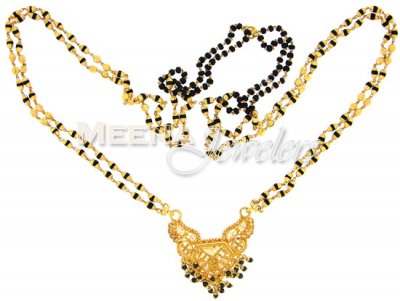
A Hindu marriage symbolizes not just coming together of two individuals, but also the bonding of understanding, commitment, mutual love, oneness and spiritual growth. Traditionally, Hindu marriage is much more than just celebration and fun. It demands sacrifice, companionship, dedication, and devotion from both the partners. Each and every rituals and customs associated with marriage portrays the real essence of wedding. Traditionally, there are five signs of marital status of women, according to Hindu culture- mangalsutra, toe rings, kumkum, bangles and a nose ring. Talking about Mangalsutra, the word denotes a significant meaning. While mangal means aupiscious, sutra can be deciphered as a thread.
Significance Of Mangalsutra In Hindu Marriage
Mangalsutra, as such, is not just a jewelry item, but a sacred thread of love and goodwill worn by married women, as a symbol of their successful marriage. An inevitable part of Hindu marriage ceremony, Mangalsutra refers to a revered symbol of wedlock. India being a land of diversity, different regions in the country have assigned different names for this scared symbol. While it is known as the thaaly or maangalyam in Kannada, Telugu and Tamil in Southern India, people in the northern part of India calls it Mangalsutra. It is believed that the concept of this sacred thread had its roots laid down in South India. Having immense significance and importance, it traveled to North India as well and today, forms an imperative part of the wedding ceremony.
Mangalsutra is the token of dignity and love given to a bride by her groom. On the wedding day, the groom ties the Mangalsutra around the neck of the bride, while the priest recites Vedic hymns and prays. It signifies the union of the bride and the groom, amidst the presence of deities, who are believed to be attending the marriage. In some regions, the groom ties first and his sisters tie the rest. Talking about its appearance, this sacred thread is made of two strings of small black beads with a locket or pendant. Sometimes, it is also made of small beads of gold and black beads, with gold and diamond pendant.
Considered auspicious for married women, mangalsutra is believed to have divine powers. Each of the black beads in the Mangalsutra, signify protection from evil power and are believed to protect the marriage of a couple, essentially the life of the husband. Hindu women feel superstitious, when this scared thread breaks or gets lost. In the present times, mangalsutra are boasts of various designs and patterns. While the Gujaratis and Marwaris often go for a diamond pendant, Maharashtrians have a pendant that consists of one or two vatis and Bengalis in the meanwhile, have coral incorporated in the designing of the Mangalsutra.
Present Scenario
Today, the concept of wearing a mangalsutra has changed considerably. It is more of a fashion statement than a symbol of marriage, thanks to modernization. With the progressive times, the wearing of mangalsutra in working women has considerably reduced. There is also a marked change in the style and making of mangalsutra over the years. Previously, women used to wear simple design mangalsutra, with small pendants, but now, the trend is to wear short length ones, that too with a single string. Instead of gold pendants, they prefer diamond ones. However, the black beads have still managed to remain constant. Whatever may be the reason to adore it, mangalsutra surely symbolizes the real essence and concept of a Hindu marriage.
